Chapter III
A Desk-Sized Flexure Stage
Sub-micron motion with no bearings at all
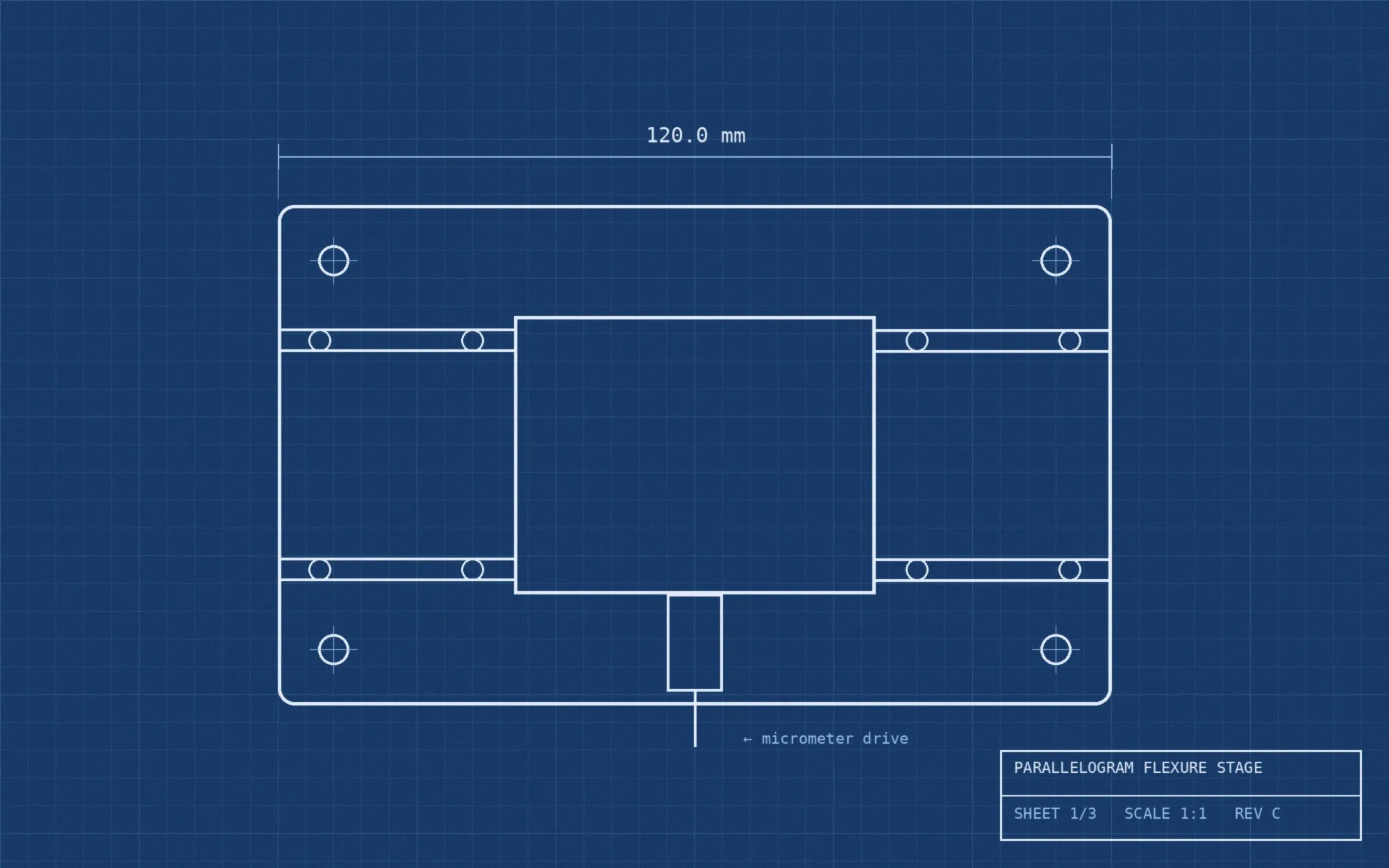
Ball bearings rattle. Sliding rails stick. A flexure doesn’t have either problem, because nothing in it slides: the whole mechanism is one piece of material that bends a little, the same way every time.
I wanted to know how good a flexure stage could be if it came off a hobby 3D printer.
Design
Four thin leaf springs hold a central platform. Push the platform and the springs bend in an S-shape, so the platform moves sideways while staying parallel to itself. It’s the same principle as a parallelogram linkage, without any pins.
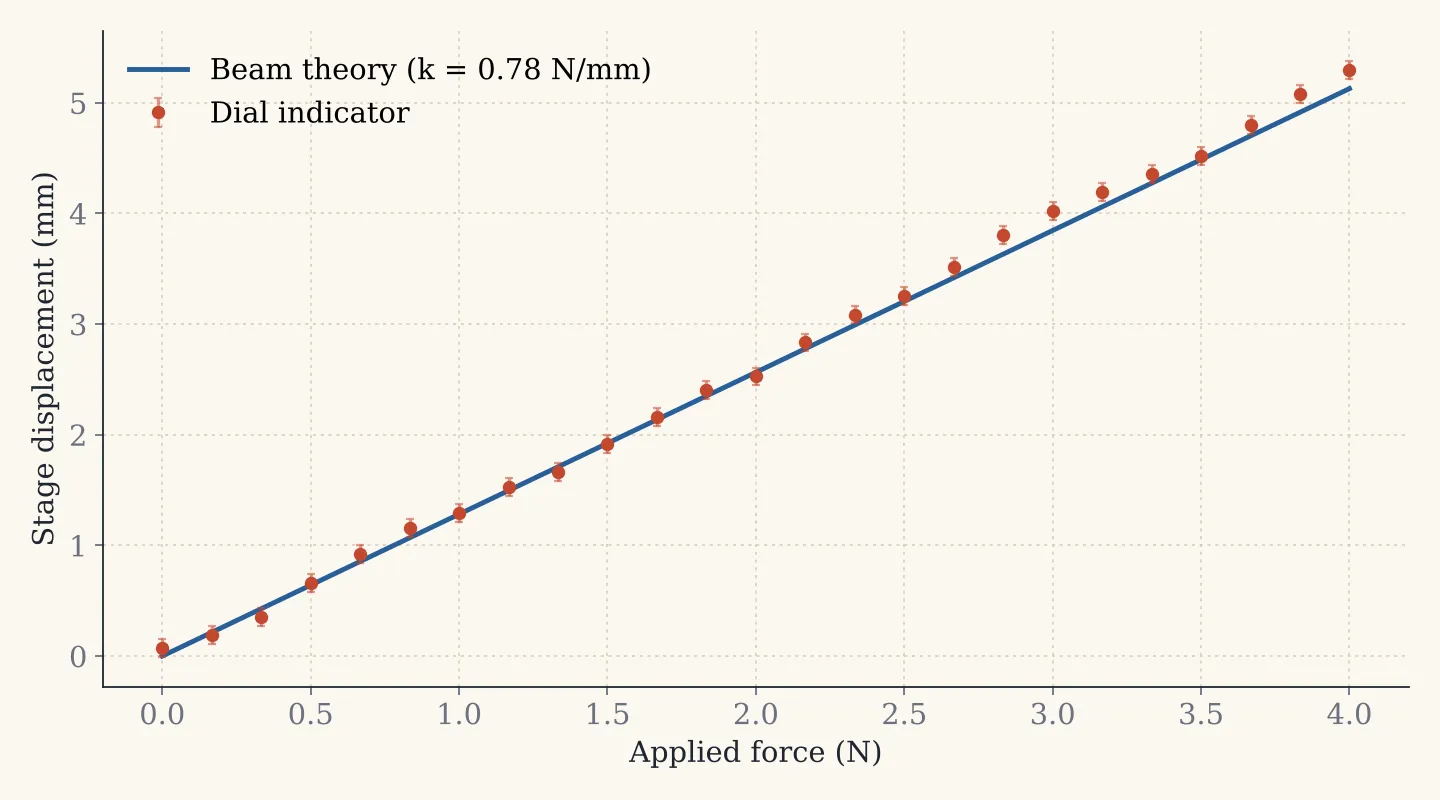
Beam theory predicts the stiffness of each leaf as , so the stage should be very linear for small motions.
Measuring it
Using a dial indicator and a set of calibration weights hanging over a pulley, I pushed the stage in 0.16 N steps.
Next steps
- Print revision C with flat leaves
- Stiffness measurement
- Add a micrometer head for repeatable positioning
- Measure parasitic (unwanted) motion with a second indicator